
This page is currently under construction. The plant species, including descriptions and pictures, will be added here gradually.
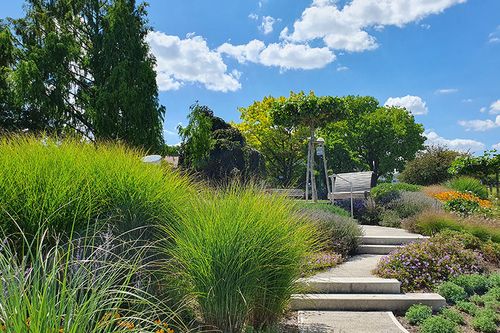
The redesign of the Donaulände will make Tulln's most beautiful public garden even richer. 19,300 climate-friendly, site-adapted native and exotic perennials and grasses thrive here. Their flowers feed countless insects throughout the growing season and make natural processes and seasonal changes visible. The new plantings - as in the whole of Tulln - are also strictly based on ecological criteria: both in terms of the origin of the plants and the care provided by Tulln's city gardeners.
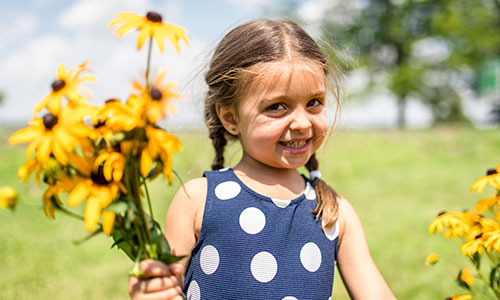
Site-specific planting in the beds
Further information on the individual plants - for example flowering color, flowering time, suitability of location and growth height - can be found further down on this page.
Are you interested in gardening tips? Our city gardeners have a few gardening tips for every season.
Resilience
Skillful plant selection: Special characteristics are required here on the wind-exposed banks of the Danube. The full-sun, wind-exposed location places high demands on the choice of plants: The perennials used are adapted to the location, tolerant of heat and drought, robust against diseases and ecologically valuable. As the planting beds are also located in the retention area of the 300-year and 1,000-year floods, the selected perennials need to be able to regenerate well. A composition of grasses and perennials was developed that plays with year-round, continuous flower sequences and combinations, visual and tactile foliage contrasts and rhythmic repetitions. The different flower shapes shine in the complementary colors violet and yellow.
Life in the soil
Covering the soil with mulch promotes soil life and significantly reduces the need for irrigation. Covering the soil surface with mineral mulch (river gravel) and in other places with organic mulch (Miscanthus chaff) has a positive influence on the development and thriving of the perennial planting. Under these pH-neutral mulch materials, the temperature and moisture conditions are more balanced, which promotes soil life and better plant growth. This significantly reduces the need for irrigation. Cultivation is carried out entirely without pesticides.
Symphonic play with the waves
The Danube as a source of inspiration for the design - a harmonious interplay of forms. The organic shapes of the perennial beds are derived from the waves of the Danube. In this way, they break up the linearity of the pathway. The unifying element is the continuous, harmonious planting of grasses and perennials. The different spatial depths and loose boundaries constantly offer new perspectives. The shape of the beds dissolves from the Danube stage towards the Nibelungen monument and continues in a teardrop shape from the landing stage to the monastery path.
Flowing shapes
Order is essential - even in flower beds: so-called "drifts" create a flowing impression. The perennials were arranged on the planting area in so-called "drifts" to create a flowing impression. When arranging the perennials, the designers had the height relief of the overall composition in mind. Taller grasses and perennials provide a backdrop for those seated, while lower plants create attractive visual connections from the benches. For the flower colors, the designers opted for colors that are opposite each other in the color wheel, i.e. the tried and tested "harmony with the opposite side".
Ecological and easy to care for
Despite the lush colors, the beds are easy to care for. One pruning a year is enough. And like everywhere else in Tulln: we maintain them strictly according to ecological criteria. The maintenance requirements of the grass and perennial beds are extremely low, especially in relation to the lush colorfulness. They are pruned once a year immediately after winter. In the fall, only tall grasses are tied together and flowers that are not stable are removed. Additional watering is designed to save water and is only carried out manually during longer dry periods. The selected species are particularly climate-tolerant, rich-flowering, long-lived and undemanding. The irregular arrangement in "drifts" also allows the individual plant species to spread dynamically and also significantly reduces the amount of maintenance required.
Site-appropriate planting - perennials
Here you will find selected species of perennials found in the planting beds with information.
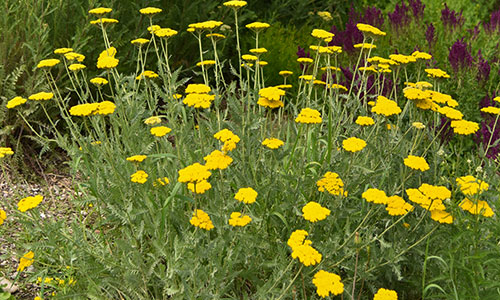
Yarrow
Botanical name: Achillea filipendulina 'Coronation Gold'
Growing height: 70 cm
Location/description: Bedding, open space, continuous bloomer
Flowering time: June-September
Flower color: golden yellow
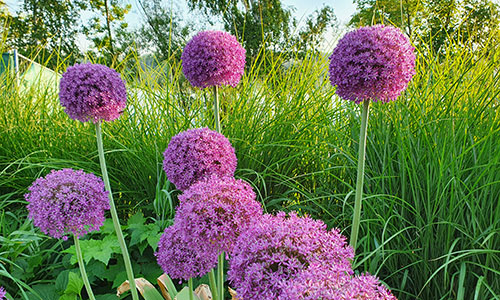
Globe leek
Botanical name: Allium aflatunense 'Purple Sensation'
Height: 80 cm
Location/description: Bedding, open space
Flowering time: May-June
Flower color: purple-violet
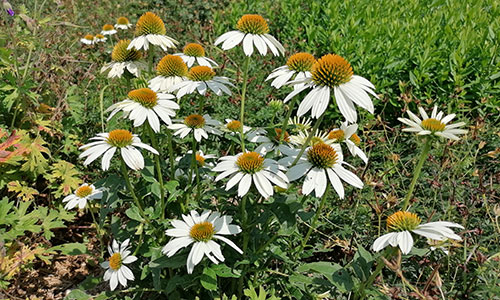
Coneflower
Botanical name: Echinacea 'PowWow White'
Height: 80 cm
Location/description: Bedding
Flowering time: July-September
Flower color: white
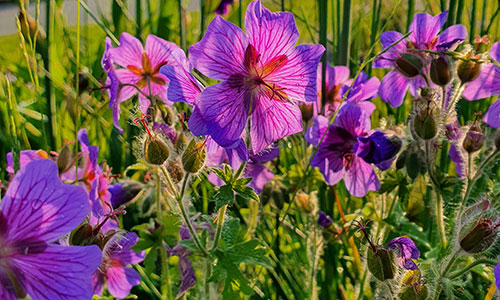
Cranesbill
Botanical name: Geranium himalayense 'Gravetye'
Height: 35 cm
Location/description: Bedding, open space
Flowering time: May-June
Flower color: blue and red veined
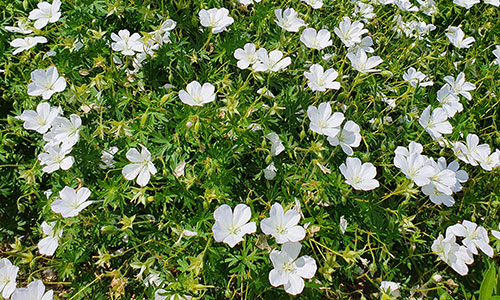
Cranesbill
Botanical name: Geranium sanguineum 'Album'
Growing height: 40 cm
Location/description: Open space, woodland edge
Flowering time: May-June
Flower color: white
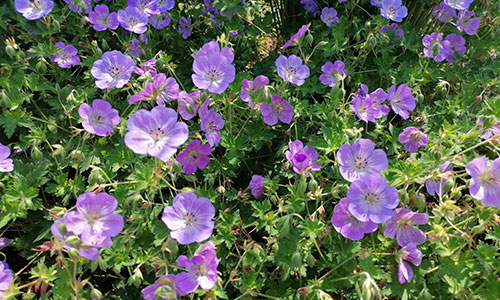
Cranesbill
Botanical name: Geranium x wallichianum 'Azure Rush'
Growing height: 45 cm
Location/description: Bed, open space, woodland edge
Flowering time: May-October
Flower color: light purple
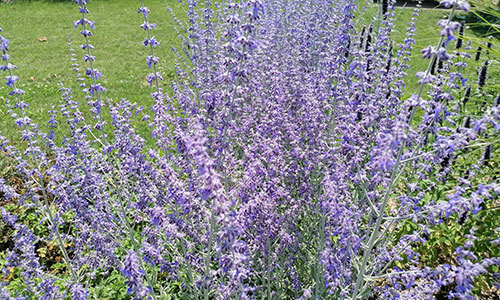
Blue rue
Botanical name: Perovskia atriplicifolia 'Little Spire'
Growing height: 80 cm
Location/description: Open space
Flowering time: June-September
Flower color: blue
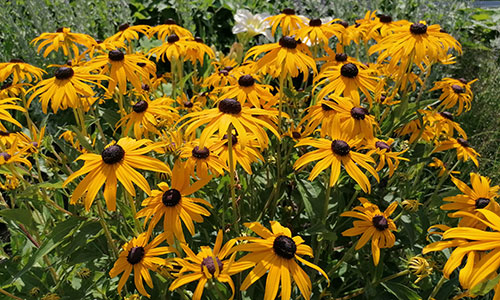
Magnificent coneflower
Botanical name: Rudbeckia fulgida 'Early Bird Gold'
Height: 60 cm
Location/description: Bedding, open space
Flowering time: May-November
Flower color: dark yellow
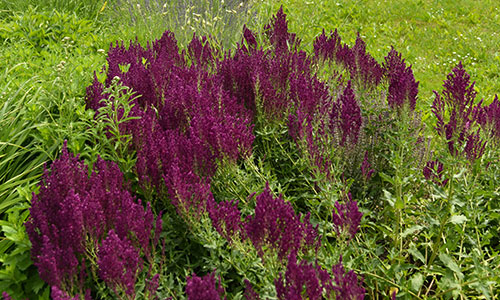
Steppe sage
Botanical name: Salvia nemorosa 'Schwellenburg'
Height: 60 cm
Location/description: Bed, open space
Flowering time: May-September
Flower color: dark purple
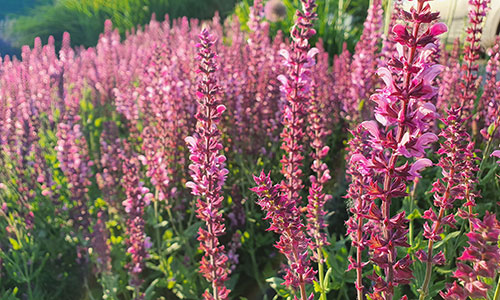
Steppe sage
Botanical name: Salvia nemorosa 'Rosa'
Height: 40 cm
Location/description: Bedding, open space, remontant
Flowering time: June-September
Flower color: pink
Other perennials used
- Fragrant nettle: Agastache rugosa 'After Eight'
- Autumn anemone: Anemone 'Honorine Jobert'
- Anemone: Anemone japonica 'Wild Swan'
- Anemone: Anemone japonica 'Whirlwind'
- Rose-flowered beauty eye: Coreopsis rosea 'Heavens Gate'
- Aster: Aster amellus 'Rudolf Goethe'
- Aster: Aster amellus 'Violet Queen'
- Aster: Aster ageratoides 'Asran'
- Spearmint: Calamintha nepeta 'Blue Cloud'
- Spearmint: Calamintha nepeta 'Triumphator'
- Globe thistle: Echinops ritro 'PowWow White'
- Daylily: Hemerocallis 'Arctic Snow'
- Daylily: Hemerocallis lilioasphodelus
- Lavender: Lavandula angustifolia 'Aromatic Blue'
- Lavender: Lavandula angustifolia 'Imperial Gem'
- Catmint: Nepeta x faassenii 'Six Hills Giant'
- Catmint: Nepeta x faassenii 'Walkers Low'
- Magnificent coneflower: Rudbeckia ful. var. sullivantii 'Goldsturm'
- Garden scabiosa: Scabiosa caucasica 'Perfecta Alba'
- Garden scabiosa: Scabiosa caucasica 'Perfecta'
Site-appropriate planting - grasses
Grass species used:
- Diamond grass: Calamagrostis arundinacea var. brachytricha
- Chinese reed: Miscanthus sinensis 'Gracillimus'
- Chinese reed: Miscanthus sinensis 'Kleine Fontäne'
- Pipe grass: Molinia caerulea 'Edith Dudszus'
- Prairie grass, dewdrop grass: Sporobolus heterolepis
- Tender feather grass: Stipa tenuissima
- Tufted feather grass: Stipa capillata
Did you know that ...
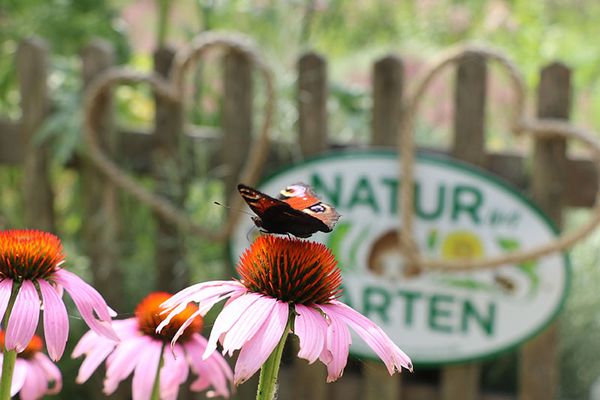
.. "Nature in the Garden" is based in Tulln and that Tulln is the first "Nature in the Garden" municipality in Austria? You can find all the important information on ecological garden design at
at www.naturimgarten.at.